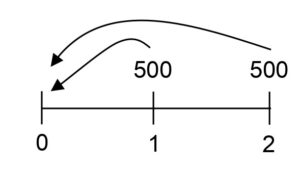
Every capital has a maturity associated with it and the same monetary capital has different values at different instants of time. In other words, if a person has 1,000 c.u. now, it would be a serious mistake to say that it equals 1,000 c.u. one year from now, or to say that it equals 500 c.u. one year from now plus another 500 c.u. two years from now.
Often you have to compare financial capitals that correspond to different moments in time.
How is financial capital added, subtracted or compared?
To understand the procedure, two financial capitals of 500 c.u. each are taken to compare them with 1,000 c.u.
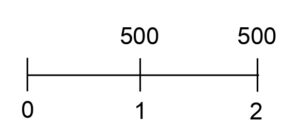
In any financial equivalency, it is useful to represent a simple diagram that includes the different capitals and their maturities, such as the one shown below: The moment represented as “0” represents the current moment; within 1 year, you get a capital of 500 c.u., and within 2 years, another capital of 500 c.u.
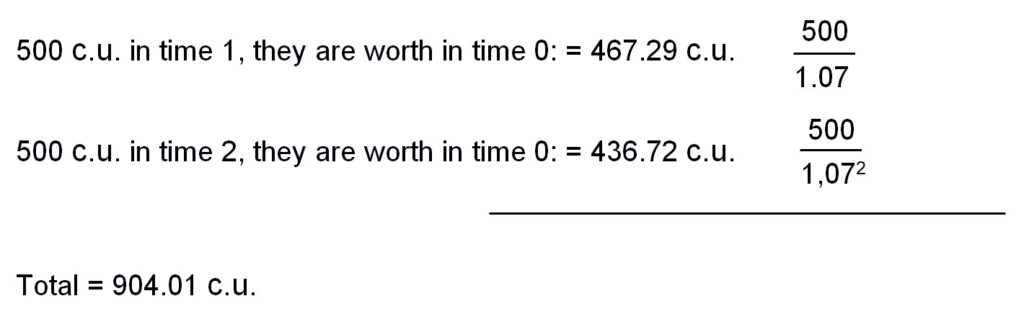
The two 500 c.u. capitals have to be added, but since they correspond to two different moments in time, a financial law needs to be applied in order to move the capitals to a common moment in time, as shown in the following diagram. Only in this way can be made a sum of two homogeneous quantities. In this particular example, assuming the annual interest rate is 7%, the receipt of two 500 c.u. capitals 1 and 2 years from today is equivalent to 904.01 c.u. today.